The standard advice is to add technical capability to your board. The only peer-reviewed study of what separates nonprofits on AI found that size, revenue and board composition predicted nothing at all. Something far cheaper did.
Search for what your board should be doing about artificial intelligence and you will find a remarkably consistent answer. Recruit a director with a technology background. Form a committee. Adopt a framework. Ask whether the board possesses adequate expertise for the oversight task ahead.
You will also find the same seven or so questions, repeated almost word for word across a dozen sources. Where are we already using AI. Who is accountable for it. What information should never be entered into these tools. How are we checking outputs for accuracy. Do we have a policy. The list is now standard furniture, and if your board has worked through it, you have done what the sector currently asks of you.
I want to make an uncomfortable argument about that list. Not that the questions are wrong, because they are reasonable questions. The argument is that the premise underneath them, that a board's contribution to AI is a matter of capability it needs to acquire, does not survive contact with the only peer-reviewed evidence we have.
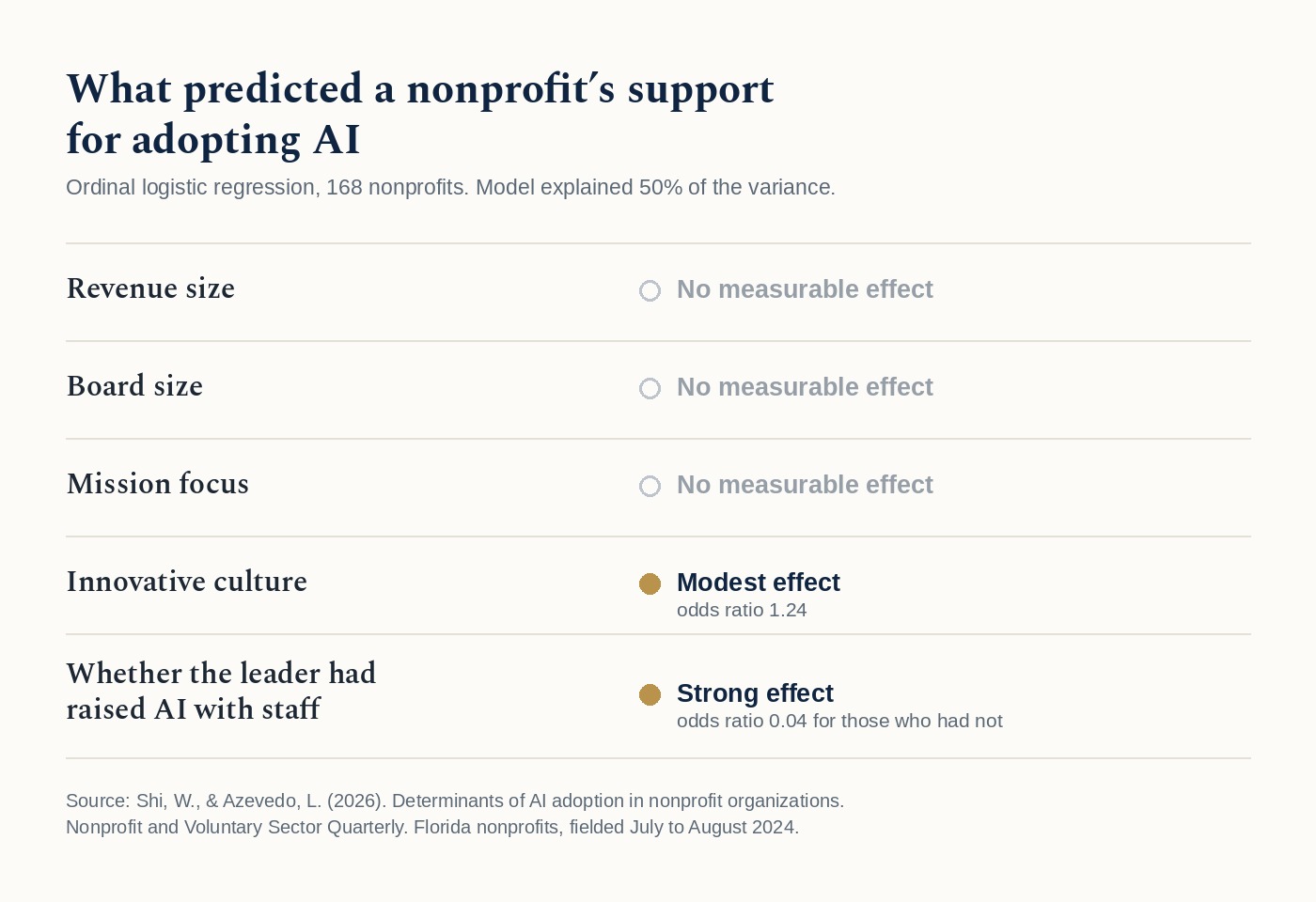
In March 2026, Nonprofit and Voluntary Sector Quarterly published the first study to test what predicts whether a nonprofit supports adopting generative AI. Wanzhu Shi of the University of North Florida and Lauren Azevedo of the University of North Carolina at Charlotte surveyed 609 Florida nonprofits and received 168 complete responses, a 28.5 percent response rate, fielded in July and August of 2024. They followed the survey with interviews of 14 executive directors.
They tested the organizational characteristics you would expect to matter. Revenue size, drawn from GuideStar, ranging from zero to just over 400 million dollars. Board size, also from GuideStar, averaging 11 members and ranging from 3 to 40. Mission focus across six subsectors.
None of the three showed statistical significance. Not revenue. Not board size. Not what the organization does.
Two things did. Organizations with a stronger innovative culture were more likely to support adoption, a modest effect. And then there is the finding that should stop a board chair mid-sentence. Leaders who had not recommended AI tools to their own staff were dramatically less likely to support adoption, with an odds ratio of 0.04 at p < .01. In a model explaining half the variance in the outcome, that variable was the outlier by a wide margin.
Fifty-six percent of the leaders surveyed had not had that conversation.
I want to be careful with this rather than oversell it, because the caveats are real and they matter.
The study surveyed nonprofit leaders, not board members. The authors say so themselves in their limitations, noting the survey "did not consider perceptions of Board members, staff, volunteers, or other stakeholders." So this is evidence about executive behavior, and applying it to boards is an inference rather than a finding.
The outcome measured is supportiveness toward adopting AI, not whether AI produced value. Those are different things, and nobody has yet published the second study.
The communication variable was measured narrowly, as whether the leader had recommended AI tools to staff. The authors read that as evidence of an internal communication process. It is a reasonable reading, and it is still a proxy.
The study is cross-sectional, so the direction of the arrow is not established. Leaders who already favor AI are plainly more likely to recommend it to staff. The conversation may be a cause, or a symptom, or both.
And the sample is 168 mostly small nonprofits in three Florida metros, gathered in the summer of 2024. It is not the sector.
Take all of that seriously and something durable is still standing. Across a real sample, the organizational characteristics that boards spend their time on had no measurable relationship to where an organization landed on AI. The thing that tracked was whether anyone inside the building had actually talked about it. Whichever direction that runs, it is the visible marker that separated these organizations, and unlike innovative culture, it is something a board can observe and require.
That is a different job than the one the standard advice describes. It says a board that adds a technology expert to its roster has changed a variable that predicted nothing. A board that causes the conversation to happen has moved the one that did.
There is a second problem with the standard list, and it is structural rather than editorial.
Ask a board the question "do we have an AI policy" and you will get a yes or a no. An organization that downloaded a template in 2024 that no one has opened since answers yes. Ask "who is accountable for AI" and you will get a name, whether or not that person has any authority or any idea they hold the role. Ask "how are we checking outputs for accuracy" and you will get an assurance from the staff member whose work is being checked.
These questions are answerable without producing information. Worse, they invite self-report on exactly the topic where self-report is least reliable, and we now have hard evidence of that.
In a study of 48,340 people across 47 countries conducted by researchers at the University of Melbourne, 57 percent of employees said they hide their use of AI and present AI-generated work as their own. Almost half reported using AI in ways that contravene their employer's policies. Sixty-six percent said they rely on AI output without evaluating its accuracy, and 56 percent said they have made mistakes in their work because of AI. That is a general workforce study rather than a nonprofit one, and it should be read as such, but the size and the design make it the most reliable picture available of what employees will and will not tell their employer.
The nonprofit-specific number is just as pointed. In a survey of 1,179 US social workers published in June 2026 by the Moritz Center for Societal Impact at UT Austin with the National Association of Social Workers, 63.5 percent said they already use AI tools in their role. Among those who answered the question, 42.1 percent said they have no role whatsoever in their organization's decisions about AI.
Put those together and the picture is clear enough. Your staff are already using these tools. A meaningful share are not telling you, some are using them against policy, and most have no voice in how the organization decides. A board that asks "where are we using AI" is asking a question that the people best positioned to answer it have documented reasons to answer incompletely.
A better question has a specific property. It cannot be satisfied with an assurance. It requires either a document, a demonstration, or an admission.
Show us the policy and tell us when someone last read it. Not whether one exists. The Stanford HAI and Project Evident survey found that 78 percent of nonprofit respondents had no policy regulating generative AI, though that was fielded in the fall of 2023 and the sector has moved since. The more useful question in 2026 is not whether a document exists but whether it functions.
Which specific tools are in use, on which accounts, and who is paying for them. Consumer accounts on personal credit cards are the most common shape of nonprofit AI use and the least visible. This question has a paper answer. If nobody can produce it, that is the finding.
What have we put into these tools that we would not put in an email to a stranger. This is the data question rephrased so that it cannot be answered with a policy. It asks about behavior, and it invites an honest answer by assuming use rather than accusing.
When AI has produced something wrong, how did we find out. If the answer is that it has never happened, the organization is not detecting errors rather than not making them. That is a more valuable thing for a board to learn than a reassurance.
Who has raised a concern about AI, and what happened to it. Concerns arrive through informal channels long before they become incidents. The question is whether there is anywhere for them to go.
What decision are we making differently because of AI, and how would we know if it was worse. This is the value question, and most organizations cannot answer it, which is the point.
Has anyone talked to staff about this. The evidence says this is the variable that moves. It is also the cheapest thing on the list.
Every version of this article that exists ends at the question list, as though asking were the deliverable. It is not. A board that asks seven good questions once a year and records nothing has performed oversight rather than exercised it.
Three things turn questions into governance.
The sector has been telling boards that AI oversight requires expertise they do not have. That advice is expensive, it is slow, and the one piece of peer-reviewed evidence we have does not support it. Board size predicted nothing. Revenue predicted nothing.
What appears to separate organizations is whether the conversation happened. Your board can cause that this quarter, without a new director, a new committee, or a consultant.
The question is not whether your board understands AI. It is whether your board has made anyone in your organization talk about it out loud.
The CNAI AI Readiness Assessment scores your organization across the dimensions that determine whether AI creates value. It takes about ten minutes and gives your board something concrete to discuss.
Sources
Borah, E., Meyerhoff, J., Al-Turk, A., Gower, K., & Mastryukova, A. (2026). Use of artificial intelligence in social work practice: Findings and recommendations from a national survey. Moritz Center for Societal Impact, The University of Texas at Austin, with the National Association of Social Workers. moritzcenter.utexas.edu
Di Troia, S., Parli, V., Pava, J. N., Badi Uz Zaman, H., & Fitzsimmons, K. (2024). Inspiring action: Identifying the social sector AI opportunity gap. Stanford Institute for Human-Centered AI & Project Evident. hai.stanford.edu
Gillespie, N., Lockey, S., Ward, T., Macdade, A., & Hassed, G. (2025). Trust, attitudes and use of artificial intelligence: A global study 2025. University of Melbourne & KPMG. figshare.unimelb.edu.au
Shi, W., & Azevedo, L. (2026). Determinants of AI adoption in nonprofit organizations. Nonprofit and Voluntary Sector Quarterly. doi.org/10.1177/08997640261429018
Charts on this page were produced by the Center for Nonprofit AI from the cited research.
A concise monthly briefing on AI strategy for the sector. Articles like this one, delivered when they publish.
 Center for Nonprofit